Abstract
This study investigates the shifting global dynamics of Artificial Intelligence (AI) research by analysing the trajectories of countries dominating AI publications between 2000 and 2025. Drawing on the comprehensive OpenAlex datasets and employing fractional counting to avoid double attribution in co-authored work, the research maps the relative shares of AI publications across major global players. The analysis reveals a profound restructuring of the international AI research landscape. The US and the European Union (representing EU27), once the undisputed and established leaders, have experienced a notable decline in relative dominance, with their combined share of publications falling from over 57% in 2000 to less than 25% in 2025. In contrast, China has undergone a dramatic ascent, expanding its global share of AI publications from under 5% in 2000 to nearly 36% by 2025, therefore emerging as the single most dominant contributor. Alongside China, India has also risen substantially, consolidating a multipolar Asian research ecosystem. These empirical findings highlight the strategic implications of concentrated research output, particularly China’s capacity to shape the future direction of AI innovation and standard-setting. Beyond publication volume, the study further examines research quality by comparing each country’s share of high-impact publications against its overall output, and analyses citation impact trajectories across major players. The findings show that in addition to China leading in volume, the country has also recently led in high-impact publications. Such an observation challenges the general assumption that Western powers retain dominance in high-impact AI scholarship.
Keywords
artificial intelligence; scientometrics; bibliometric analysis; global research dominance; academic publications; United States; China; European Union
Introduction
The influence of the field of Artificial Intelligence (AI) has rapidly expanded to diverse domains, including global economic competitiveness (Khan et al., 2024), geopolitical relations (Gerlich, 2024), and societal transformation (Gohil, 2023). Its global impact spans sectors from healthcare (Mahdi et al., 2023) and finance (Aldasoro et al., 2024) to defence (Carlo, 2021) and manufacturing (Hong et al., 2025), making the capacity for innovation in AI an impactful indicator of a country’s future strength and competence. Consequently, understanding the global landscape of AI research—specifically, which countries dominate the production of scholarly work and how this dominance evolves over time—is necessary for policymakers, educators, and industry leaders to make informed decisions.
While global leadership in AI is often quantified through metrics such as venture capital investment, the number of successful startups, or the volume of patent applications (HAI, n.d.)—all valuable indicators of commercialisation—the fundamental basis of enduring technological capability remains its academic publication record. Scholarly articles not only record new discoveries and algorithmic breakthroughs but also act as a leading indicator, signalling emerging research directions, highlighting institutional and national strengths, and supplying the open, foundational knowledge upon which future technological development is built. Therefore, a systematic, long-term analysis of the geographical distribution of AI research output, specifically academic publication dominance, provides a crucial perspective which is often overlooked or underestimated by economic indicators.
This study leverages the comprehensive, open-source OpenAlex datasets to map the shifting dynamics of AI publication dominance across the world’s leading research countries and regional blocs between 2000 and 2025. In this study, I treat the year 2000 as a meaningful baseline, predating both the rapid deep learning advancement of the early 2010s and China’s surge in AI publication output. Analysing data between 2000 and 2025 allows us to understand the entire transition in global AI publication competition from Western-led dominance to the present multipolar landscape. This has created a competitive environment where the historic dominance of established players, such as the US and the European Union (EU), is actively being challenged (Bertelsmann Foundation, 2023). This study offers an opportunity to track the shifting trajectories of these established players alongside the rapid ascent of new powerhouses, most notably China, whose national AI strategy has explicitly prioritised academic output. By observing these simultaneous trajectories, I can dissect and comparatively analyse the evolution of a global and fiercely contested research frontier. To be precise, this study aims to satisfy two research aims. First, I am going to map the longitudinal trajectories of AI publication dominance across major countries and regional blocs between 2000 and 2025. Second, I am going to comparatively analyse whether countries with notable changes in publication volume have proportional variations in research quality and citation impact, and to examine the causal dynamics within these trajectories.
Literature Review
The study of scientific progress and the measurement of national innovation capacity, known as scientometrics, forms the theoretical foundation for this research (Mingers & Leydesdorff, 2015). In recent decades, bibliometric analysis has become the standard tool for assessing research performance (Hood & Wilson, 2001). However, applying these methods to highly dynamic, interdisciplinary fields like AI presents unique methodological challenges. The literature review is structured around two key areas: the definition and measurement of AI research and the historical and contemporary global landscape of AI production.
Defining and Measuring AI Research
A central challenge in accurately tracking AI research stems from its multidisciplinary nature. The AI field bridges core computational disciplines, such as computer science and mathematics, and overlaps with engineering, cognitive science, and specialist domains like biomedicine (Abbonato et al., 2024). Consequently, early scientometric studies often relied on narrow, fixed keyword searches or incomplete institutional affiliation lists, a method prone to both exclusion (by missing new subfields) and bias (by over-representing traditional computer science outlets) (Bruce et al., 2025). The consensus in modern scientometric practice, exemplified by approaches adopted by the OECD.ai Observatory, designs the methodology beyond simple keyword approaches. Instead, leveraging comprehensive, curated databases like OpenAlex, which categorise papers based on robust, continuously updated field-of-study taxonomies, is crucial. This advanced approach, adopted in this research paper, focuses on papers explicitly classified under “AI” or “machine learning.” While this provides a conservative yet high-confidence measure of core AI research output, it ensures consistency and avoids the unreliable categorisation stemming from emerging terminology.
Liu et al (2021) introduced a bibliometric definition for AI using a hybrid approach—starting by searching core keywords, then extracting high-frequency terms—and compared the outputs against three existing search strategies applied to Web of Science data. Liu et al. (2021) concluded that different search strategies result in substantially different corpus sizes and compositions, while there is no single universally agreed bibliometric definition for AI. Also, Färber & Tampakis (2024) used scientometric data across multiple scholarly databases to compare academic- and company-authored AI publications. Their findings imply that taxonomy choices are contingent on research objectives. Gao et al. (2024) empirically analysed patent-cited AI papers relative to the non-patent-cited counterparts from 1999 to 2013. Their findings show that patent-cited papers have stronger scientific impact, especially for conference publications. Gao et al.’s (2024) study highlights that not all AI papers are equal in impact.
Furthermore, the literature debates the appropriate counting methodology (Mingers & Leydesdorff, 2015). Simply counting the total number of published research papers leads to inflation due to increasing co-authorship. Consequently, fractional counting, where credit for a publication is divided equally among the affiliated institutions or countries (as detailed in my methodology), has become the gold standard for accurately representing the proportional contribution of each entity. Fractional counting is employed in the methodological design of this research paper.
Publication volume, despite being an indicative metric, fails to fully represent a country’s scientific advancement in AI. Bibliometric literature distinguishes between quantity and quality, and citation counts are the most widely used proxy for research quality and impact (Hood & Wilson, 2001). High citation counts do not necessarily follow from high publication volume. A country can dominate in output whilst failing to earn proportional scientific influence, and vice versa (Färber & Tampakis, 2024). Such a quality–quantity differentiation is especially obvious for AI publications, as demonstrated by Gao et al. (2024).
The Evolving Global Landscape of AI Dominance
The narrative of global AI dominance has undergone a seismic shift since the turn of the millennium. Prior to 2010, the US and Western Europe, particularly the EU bloc, were the undisputed leaders in AI publications (Bertelsmann Foundation, 2023). This early dominance was a direct reflection of their well-established university systems, robust governmental funding mechanisms dating back to the mid-20th century, and a culture of open academic research (Lecun et al., 2015). The pre-2010 era was characterised by steady but incremental growth among these established players, who benefited from decades of intellectual and infrastructural investment. A comparable trajectory has been documented by Carchiolo and Malgeri (2024), whose bibliometric analysis identifies a crossover between China and the US in AI publication volumes. I verify such a pattern in Figure 5 of this study. However, it is noteworthy that Carchiolo and Malgeri’s (2024) analysis relies on Scopus but not OpenAlex, employs raw publication counts but not fractional percentage shares, uses a bespoke set of 18 keywords but not the OECD field-of-study taxonomy, and covers a different timeframe (1995-2023), meaning that my study is methodologically different than, and complementary to, theirs.
The decline of the West in AI publications can partly be justified structurally. It is noteworthy that following the UK’s formal departure from the EU in January 2020, this study accounts for the Brexit by treating the UK as an independent trajectory, excluding from the EU27 aggregate at any point, including pre-2020 years. An European Commission report (Balland et al., 2025) finds that European research and innovation hubs are significantly less closely connected than their American counterparts, especially in AI technologies. The report attributes this situation to the structural fragmentation across national borders, such as separate regulatory regimes, decentralised funding architectures, and limited cross-regional collaboration. In the US, in contrast, Jurowetzki et al. (2021) quantify the growing flow of AI researchers from academia into private technology companies. They discover that researchers specialising in deep learning and those with higher citation impact are most likely to transition from academia to private technology companies. Such a circumstance raises concerns about the privatisation of AI knowledge and the weakening of the public academic research sphere. As a result, this circumstance explains why the American academic publication share is declining even though the country remains commercially dominant. The research activity has migrated out of the academic sphere into industry labs whose outputs are less likely to appear in the OpenAlex corpus. Jurowetzki et al. (2025) second that highly cited researchers from prestigious institutions are relocating to major tech firms, where, upon the transition, their research shows reduced novelty and citation impact.
However, the literature from the past decade highlights the dramatic, centrally-driven emergence of East Asian nations, particularly China (Hamilton-Hart & Yeung, 2021). Numerous policy analyses and bibliometric reports track China’s aggressive, sustained investment in AI talent acquisition, large government funding directed by national strategic plans, and infrastructural build-out, all leading to an exponential rise in publication volume (Podda, 2025). This literature suggests that China’s rise in AI research did not only contribute to the overall global output; rather, it challenged the relative dominance of the West (Podda, 2025). My research, which uses the percentage of global AI publications by country as the key measurement metric, specifically addresses the comparative nature of this global transition, in order to track relative dominance trajectories of given countries. The empirical findings, which demonstrate the US and EU27 shares of global AI publications falling dramatically while China’s share has surged to over one-third of the global total by 2025, indicate the need for close examination of the underlying competitive dynamics and their geopolitical implications.
Methodology and Data
This study employs a quantitative, data-driven approach to analyse the shifting global dominance in AI publications between the years 2000 and 2025. The analysis focuses on tracking the publication output trajectories of countries to reveal the relative evolution of the global AI research landscape. The subsequent subsections detail the data source, criteria for identifying AI publications, and the specific counting methodologies employed for both publication quantity and cross-national collaboration.
In this study, I examine 12 units of analysis (meaning 11 individual countries and the EU27 as a collective regional bloc), based on two selection criteria. First, each unit represents a consistently leading contributor to global AI publication output between 2000 and 2025, accounting for the substantial majority of fractional-counted global share in any given year. Second, the selected units correspond to the primary geopolitical actors in contemporary AI governance, strategy and competition discourse, which include the US, China, the EU, India, the UK and other leading Western and Asian economies. I ground the bibliometric analysis in the broader policy context to which the empirical findings are intended to contribute. Countries excluded from this study is due to the fact that their fractional share of global outputs remains sufficiently small where their inclusion would not materially affect the comparative trajectories this study is designed to explore.
Data Source and Scope
The primary data source for this research is publicly accessible OpenAlex datasets (Priem et al., 2022), downloaded from a comprehensive, open-source bibliographic database. OpenAlex succeeded the Microsoft Academic Graph (Sinha et al., 2015; Wang et al., 2019) and is currently maintained by The OpenResearch Foundation. It provides extensive coverage, encompassing over 245 million research outputs, including journal articles, conference proceedings, and workshop papers. The datasets offer rich bibliographic records, including information about authors, institutions and their corresponding countries, publication venues, and fields of study. Furthermore, all records are tagged with a set of 65,000 topics sourced from Wikidata, and the datasets include citation data, which facilitates the analysis of research impact and citation networks. Its comprehensive nature and interoperability make it an ideal foundation for large-scale scientometric studies. On OECD.ai, the datasets downloaded are in the form of static csv files. These publicly accessible datasets are not compiled from a live query via the OpenAlex API. I should note that publication figures for 2025 may underrepresent the full annual outputs, as indexing delays may occur where work recently published in late 2025 may not be made available within the OpenAlex database. As I developed the descriptive and the inferential analysis outputs in late 2025 and early 2026 respectively, the 2025 data presented in this paper should be interpreted as provisional but not complete.
Identification of AI Publications
The research scope is focused on the subset of publications relevant to AI, aligning with the criteria utilised by the OECD AI Policy Observatory (OECD.ai). A publication within the OpenAlex datasets is categorised as an AI paper if it is tagged during the concept detection operation with a field of study belonging to either the “AI” or the “machine learning” fields within the OpenAlex taxonomy. It is important to note that results from adjacent fields of study—such as “natural language processing,” “speech recognition,” and “computer vision”—are only included if they also concurrently belong to the aforementioned core “AI” or “machine learning” classifications (OECD.ai Observatory, n.d.). As this classification relies on rigorous taxonomic assignment, the resultant body of AI publications for the analysis is likely to be conservative, providing a high-confidence set of AI-focused research outputs.
Publication Counting Methodology
To establish the absolute trajectory of publication output for each country, a fractional counting methodology is employed to avoid the problem of double-counting in co-authored publications. While each publication counts as one unit towards an entity (a country or an institution) in absolute terms, credit for multi-authored papers is distributed equally among the institutions involved. Specifically, a publication written by multiple authors from different institutions is fractionally split among each author based on their institutional affiliation. For instance, if a publication lists four authors affiliated with institutions in the US, one author from an institution in China, and one author from a French institution, the publication is attributed as follows: the US receives 4/6 (four-sixths) of the publication count, China receives 1/6, and France receives 1/6 (OECD.ai Observatory, n.d.). Such counting strategies ensure that the quantity measure accurately reflects the distributed contribution of each country. It is important to note that fractional counting does not fully resolve cases where a single author holds simultaneous affiliations across two or more countries. For example, a researcher with joint appointments at institutions in the US and China. In such cases, credit assignment depends on how OpenAlex disambiguates affiliation metadata at the record level, which may not be consistent across all entries in the datasets. Such an approach represents a known limitation of bibliometric analyses relying on institutional affiliation data and is acknowledged as such in the interpretation of empirical findings.
Methods
I conducted all quantitative analyses via Python (for inferential analysis) and STATA (for descriptive analysis). I processed multiple datasets directly downloaded on OECD.ai via OpenAlex and structured in Python using the pandas library for data manipulation. My descriptive trend analysis and longitudinal trajectory mapping were performed across 2000-2025. I, then, assessed concentration dynamics using the Herfindahl–Hirschman Index (HHI), with trend significance evaluated through the Mann–Kendall non-parametric test and magnitude estimated via Sen’s slope. I further examined convergence and divergence patterns through both sigma-convergence (σ-convergence) and beta-convergence (β-convergence) regression. I identified structural breaks in country-level publication trajectories using the Bai–Perron multiple breakpoint procedure. I, moreover, explored the relationship between publication volume and high-impact output share through a panel regression framework comparing each country’s share of high-impact publications against its overall output share. I, in addition, tested causal dynamics between country trajectories using panel Granger causality analysis. The figures I created for inferential analysis were built using the matplotlib and seaborn libraries in Python, while those for descriptive analysis were made via STATA.
This study specifically uses the datasets displaying the percentage of AI publications instead of the actual number of AI publications by country over time. This means in any given year, the cumulative percentage of AI publications by all countries globally is 100%. This study decides to use the percentage of AI publications by country metrics as this research paper focuses on comparative data analysis between globally dominant countries. Studying the percentage of AI publications by country longitudinally allows us to understand the trajectory of such dominance of a given country (1) over time and (2) relative to that of other countries.
I performed the HHI as a standard measure of market/system concentration, calculated by summing the squared publication shares of all countries in the datasets in a given year. Values closer to zero indicate dispersed output across many countries; higher values represent concentration in fewer dominant players. Unlike descriptive share trajectories, which show individual country trends, the HHI allows featuring the system-level distribution of AI publication output in a single annual index value. This approach enables my assessment on whether the global landscape as a whole is becoming more or less concentrated over time. I then applied the Mann–Kendall non-parametric test to examine whether any trend in the HHI time series is statistically significant, and Sen’s slope to estimate the magnitude of change per year. Mann–Kendall makes no assumption of normality in the time series and is robust to outliers, which satisfy the features of a 25-year annual index.
I, next, performed the σ-convergence and β-convergence as the two complementary approaches drawn from economic growth convergence literature. σ-convergence measures whether the dispersion of publication shares across countries—measured by the standard deviation of shares in each year—is narrowing or widening over time. β-convergence tests whether countries with initially lower shares tend to grow faster than those with initially higher shares, using a regression of share growth on initial share level. The convergence framework assesses whether the global AI publication landscape is becoming more equal or polarised across countries. These complementary approaches allow testing whether cross-country variation in publication shares is shrinking or expanding over time, and whether initially lower-share countries are closing the gap with initially higher-share counterparts.
I also carried out the Bai–Perron procedure to statistically identify multiple structural breaks (meaning points in a time series where the underlying trend changes significantly). This procedure tests sequentially for the presence and location of breakpoints in each country’s publication share trajectory. The following figures suggest that several countries experienced notable directional changes at specific points in time, especially around the early 2010s. The Bai–Perron procedure provides a data-driven test for the inflection points. Carrying out the Bai–Perron procedure is highly suitable given the nature of my datasets because multiple structural breaks maybe present in a single series and this approach can statistically identify them. In doing so, I am able to examine whether each country’s AI publication share trajectory contains one or more statistically significant structural breaks and at what year(s) these breaks per se occur. Identifying a common structural break year across multiple countries provides evidence of a system-level transition in the global AI publication landscape.
I, in addition, conducted a panel regression analysis to compare each country’s share of high-impact AI publications against its share of overall AI publications covering all 12 units of analysis from 2000 to 2025. The dependent variable is the high-impact publication share; and the independent variable is the overall publication share. I included country and year fixed effects to control for unobserved heterogeneity across units and time. I would like to test whether a country’s share of overall AI publications is a reliable predictor of its share of high-impact publications. I would like to examine whether specific countries systematically over- or under-perform on AI publication quality relative to their volume, too.
I, last but not least, performed the Granger causality to statistically test whether past values of one time series help predict future values of another. I tested for all country pairs using a vector autoregressive framework. The descriptive and aforementioned inferential analyses establish what has changed in the global AI publication landscape. Granger causality, furthermore, addresses why such changes have occurred. This means I evaluated whether knowing a country’s trajectory in prior years improves prediction of another country’s trajectory beyond what the latter’s history record already suggests.
Empirical Findings
In this research, I focus on major global players in AI publications in Europe, Asia and North America. Figure 1 and Table 1 show the AI publications over year for selected European countries. EU27 refers to the 27 member states of the EU. It is noteworthy that the UK left the EU on 31st January 2020 after Brexit. The UK is treated as a fully independent trajectory throughout this study and is not included within the EU27 aggregate at any point, including pre-2020 years, to ensure longitudinal consistency. I see that EU27 shared 29.53% of global AI publications in 2000. The share dropped to some 22% to 23% between 2005 and 2015. Over the last decade, such figures have continued to drop significantly, to 12.40% in 2025. Among Western European countries, the UK and Germany have been leading AI publications from 2000 to 2025.
Figure 1:
Publications Over Year for Selected European Countries
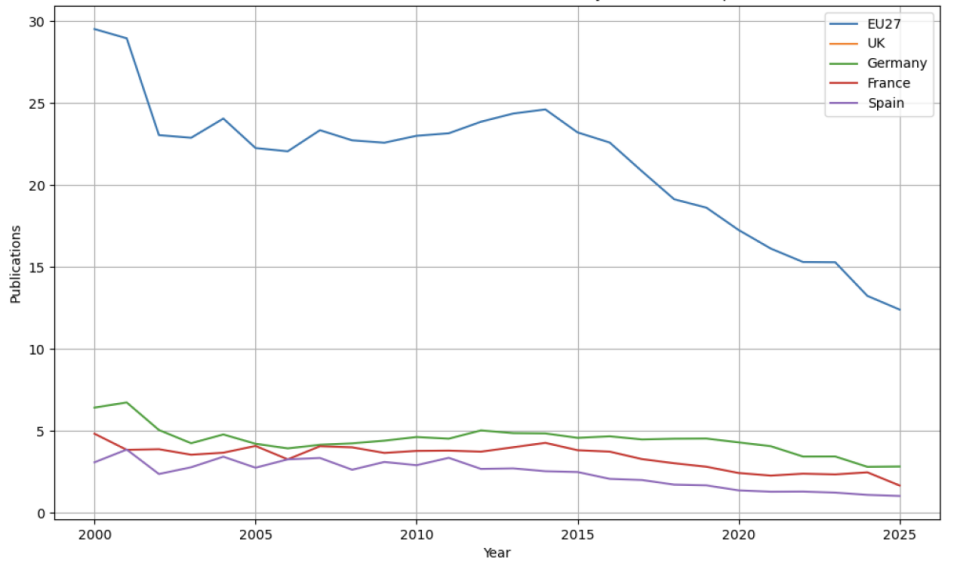
Table 1:
Publications Over Year for Selected European Countries
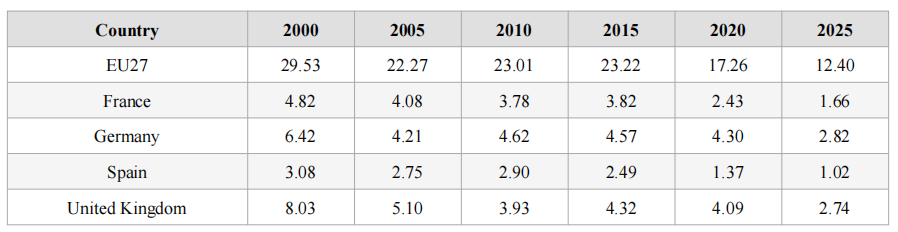
Figure 2 and Table 2 show the AI publications over year for selected Asian countries. In Asia, Japan used to be a very major global player in AI publications in the 2000s. Its contribution to global AI publications, however, has declined since 2010s. In contrast, China only contributed to just below 5% of global AI publications in 2000. In 2005, the figure soared to 18.29%. China’s dominance of global AI publications has continued to grow, reaching about 36% in 2025. Over the last decade, other than China, India has become the leading Asian player in contributing to global AI publications (about 10% of all AI publications are authored by Indian researchers in 2025).
Figure 2:
Publications Over the Year for Selected Asian Countries
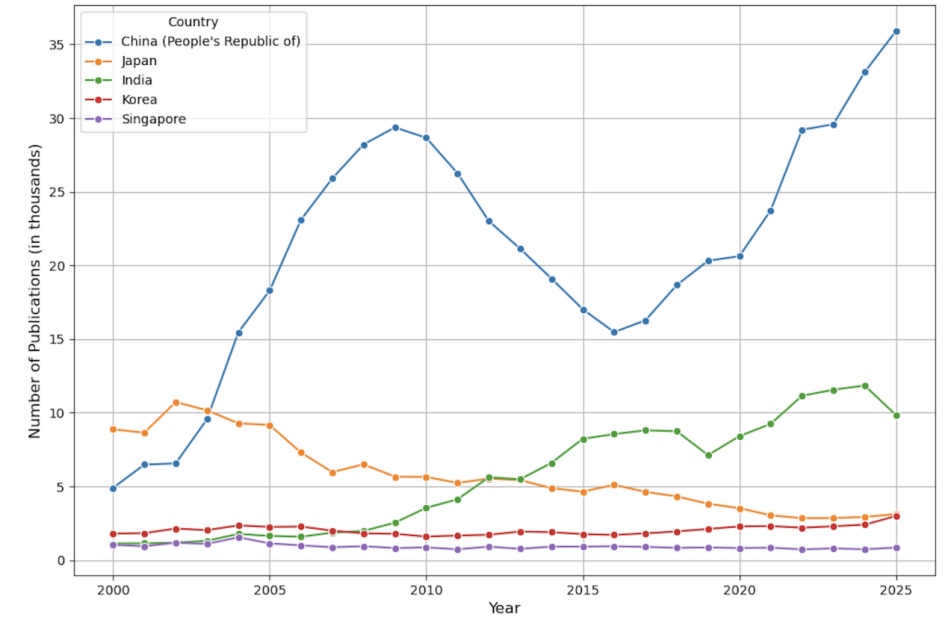
Table 2:
Publications Over the Year for Selected Asian Countries
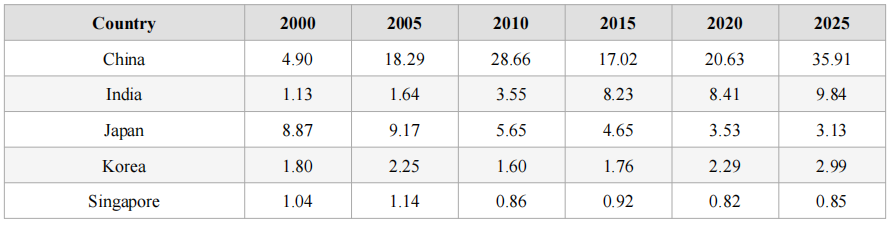
Figure 3 and Table 3 show the AI publications over year for selected North American countries. In North America, Canada’s contribution to AI publications has dropped by half between 2000 (3.32%) and 2025 (1.67%). The US, while maintaining its global dominance in AI publications, has also seen its percentage of AI publications cut by half between 2000 and 2025, from 27.56% to 12.01%.
Figure 3:
Publications Over Year for Selected North American Countries
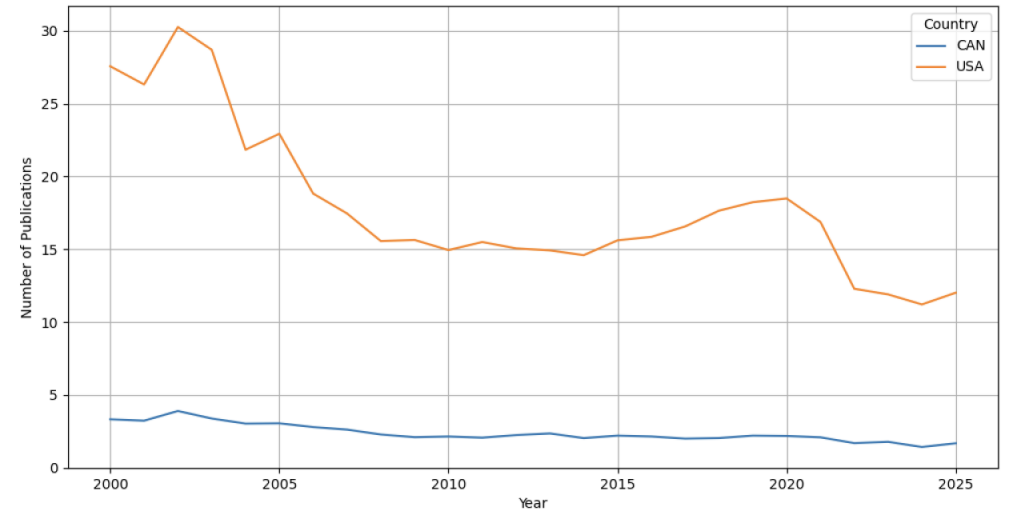
Table 3:
Publications Over Year for Selected North American Countries

Figure 4 and Table 4 show the AI publications over year between the US and China. These empirical outputs allow us to comparatively analyse the trajectories of percentage of AI publications by the world’s two leading forces. I see that in 2000, the US dominated 27.56% of global AI publications, which was over five times higher than the 4.90% from China. Between 2005 and 2006, China’s global AI publication contributions reached the level of the US. From 2006 to 2016, China’s contributions to global AI publications outnumbered those of the US. Their contributions to global AI publications maintained at very close levels between 2016 and 2017. However, since 2020, China’s dominance in AI publications has surged, while the US’s dominance has declined. In 2025, China has contributed three times as many AI publications as the US (35.91% vs 12.01%).
Figure 4:
Publications Over Time for United States and China
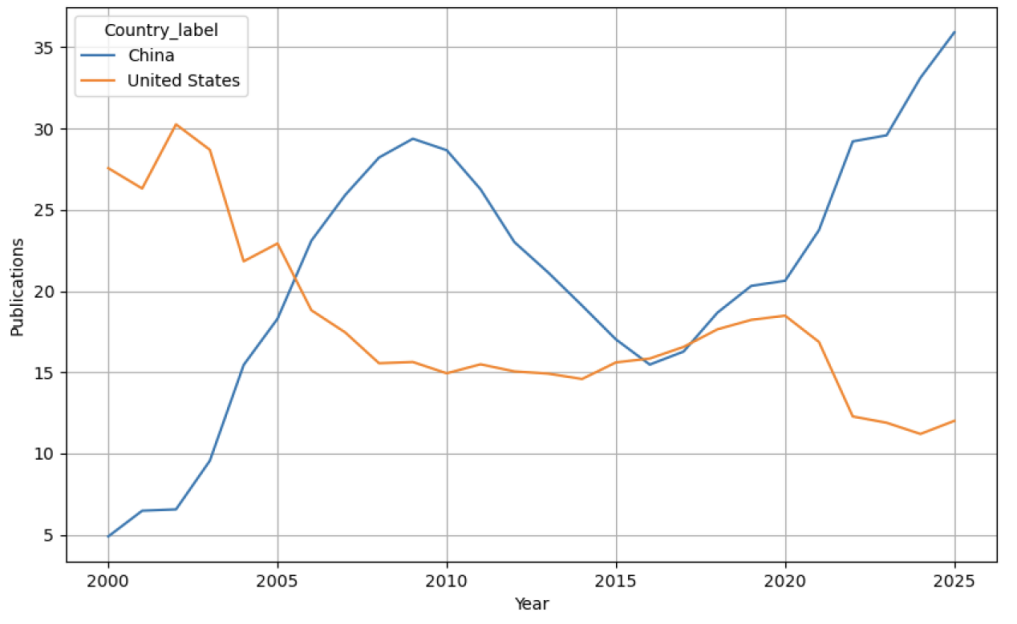
Table 4:
Publications Over Time for United States and China

Figure 5 and Table 5 supplement the preceding empirical outputs by showing the AI publications over year between the US, China and EU27. I see that in 2000, the US and EU27 were the two leading powerhouses in contributing to global AI publications. In 2005, China joined the US and EU27 to become one of the clear-cut leading global players in AI publications. All three players’ dominance in AI publications had been relatively close until 2020. Since 2020, the contributions to AI publications by the US and EU27 has declined consistently, while China’s dominance has reached new heights.
Figure 5:
Publications Over Time for United States, China, and EU27
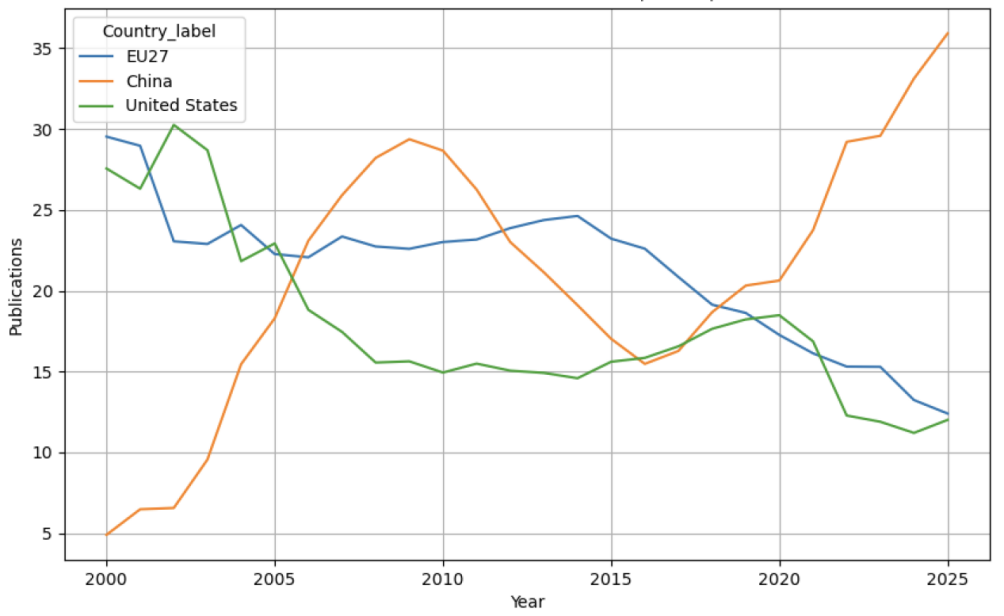
Table 5:
Publications Over Time for United States, China, and EU27

Figure 6 and Table 6 show the AI publications over time between China and non-China global players combined. Non-China global players combined refers to all EU27 countries, the US, Canada, the UK (where applicable), Japan, Korea, Singapore and India. I can see that all these major global players (including China) have combined for over 78% of AI publications annually between 2021 and 2025. In 2021, China’s contributions were fewer than half of those from all other major global players combined (23.74% vs 54.32%). Yet, China’s dominance has continued to grow, while the combined contributions from all non-China major global players have dropped slightly year by year, between 2021 and 2025. In 2025, China’s contributions to global AI publications reached 35.91%, while all non-China global players combined for 45.64%.
Figure 6:
Publications Over Time for China and Non-China Global Players Combined
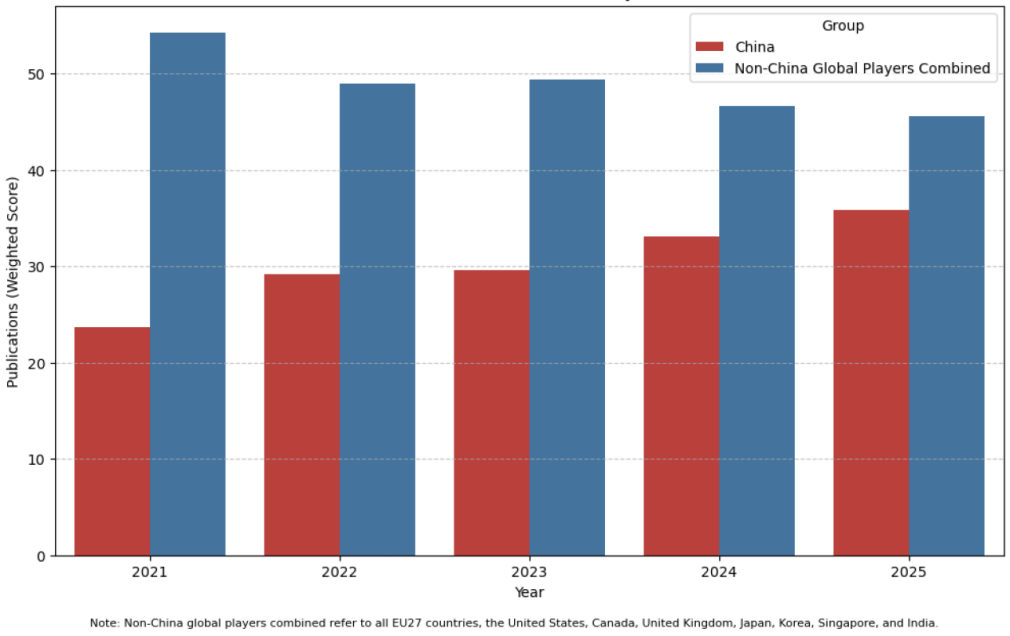
Table 6:
Publications Over Time for China and Non-China Global Players Combined

Figure 7 and Table 7 show the year-over-year (YOY) percentage change in publications over year between the US, China and EU27. I see that China’s YOY percentage change resulted in a boom during mid-2000s. China experienced another YOY percentage change boom in early 2020s. Whenever China’s YOY percentage change booms occurred, the US’s YOY percentage changes plummeted. This is understandable as percentage change in global AI publications is a relative measurement. When one dominant player results substantial positive YOY change, logically the other dominant player ends up having notable negative YOY change.
Figure 7:
Year-Over-Year Percentage Change in Publications for United States, China, EU27
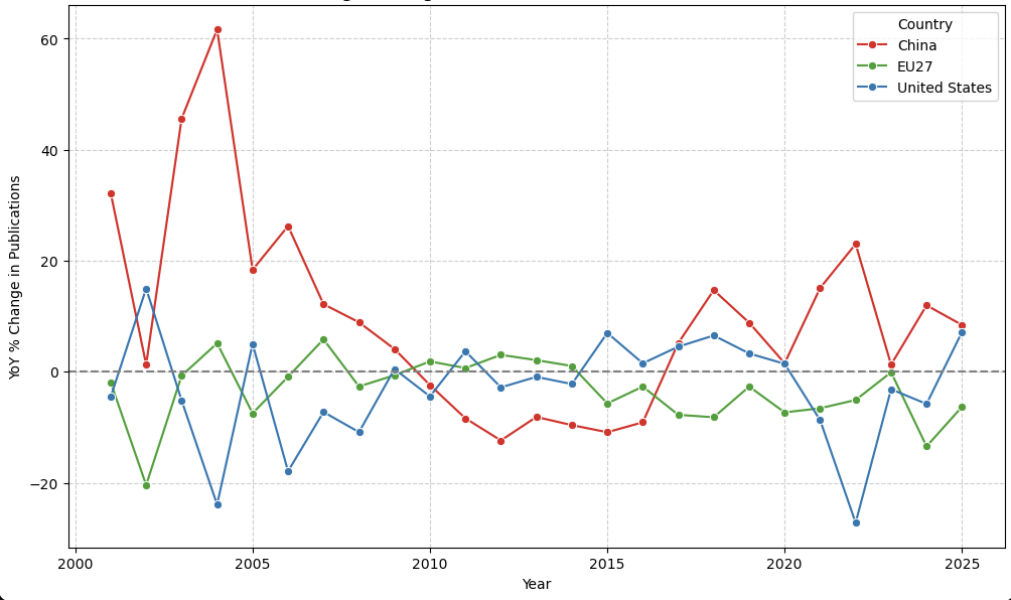
Table 7:
Year-Over-Year Percentage Change in Publications for United States, China, EU27

Figure 8 presents the HHI analysis of global AI publication concentration across the study period. The index shows a sustained upward trend, indicating that output has become progressively more concentrated among a smaller number of dominant players. The Mann–Kendall test confirms that the trend is statistically significant in the 2013-2025 sub-period (τ=0.67, p=0.002), with Sen’s slope estimating concentration increasing at +8.16 HHI units per year. The finding complements the individual country trajectories presented in Figures 1-7, by highlighting the system-level distributional transition that single-country graphs fail to display. The global AI publication landscape has become structurally more concentrated since 2013—the time period where I witnessed deep learning breakthrough and the intensification of China’s national AI investment strategy—with a shrinking number of dominant players accounting for an increasing share of global output.
Figure 8
Market Concentration of AI Publication Shares (HHI), 2000-2025, among 12 Major Global AI-Publishing Countries
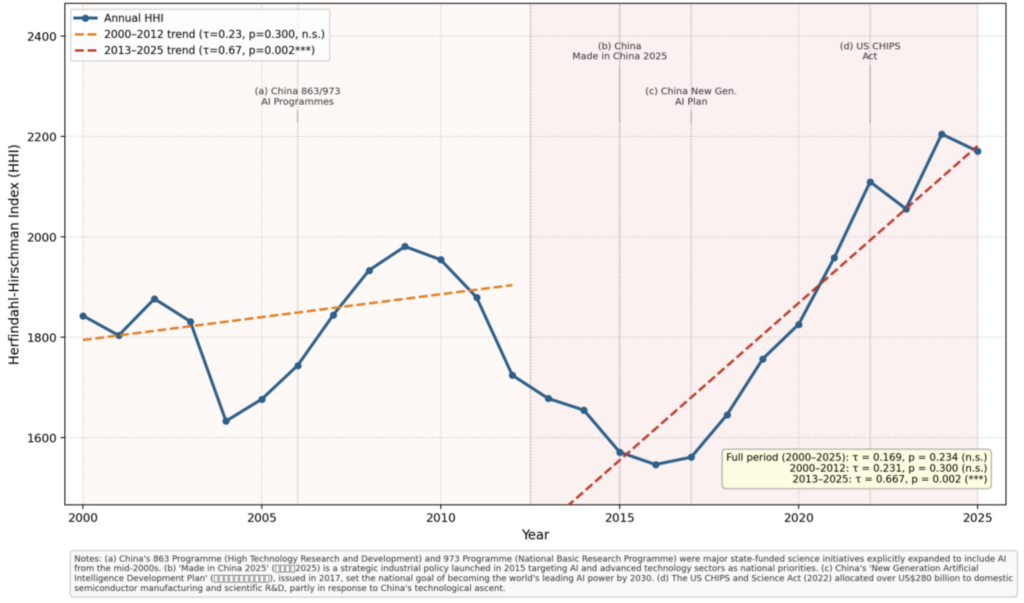
Figure 9 presents the convergence analysis of AI publication shares across the study period. The σ-convergence results show that the standard deviation of publication shares increasing from σ=0.987 in 2000 to σ=1.155 in 2025. I can see a particularly notable upward trend in the 2013-2025 sub-period, indicating that cross-country dispersion has grown over time. The β-convergence regression shows there is no statistically significant relationship between initial publication share and subsequent growth rate (β=0.0007, p=0.9121, R²=0.0000, N=300). This finding indicates that countries with initially lower publication shares have not increased their shares at a faster rate than those with initially higher shares. Overall, the empirical findings shown in Figure 9 suggest the global AI publication landscape is diverging but not converging. Here, dominant players are not being systematically challenged by lower-share countries, and dispersion across the countries studied has widened considerably since 2013.
Figure 9(a) (Left)
σ-Convergence (Cross-Country) Dispersion of AI Publication Shares
Figure 9(b) (Right)
β-Convergence (Initial Share vs. Subsequent Growth Rate, 2000-2025)
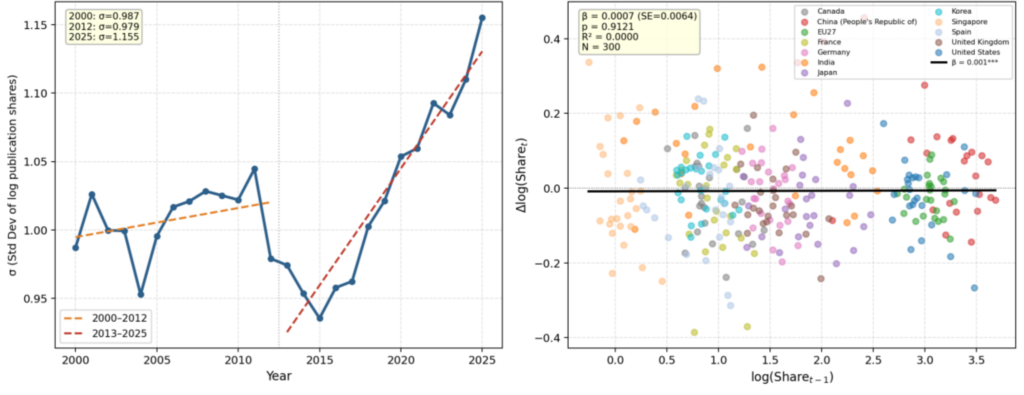
Figure 10 presents the Chow test structural break detection results for five countries across the 2000-2025 period. Three countries share a common structural break year of 2012: China (F=29.5, p<0.001), EU27 (F=28.8, p<0.001), and India (F=11.4, p<0.001). The US and Japan share a different common break year of 2006, each with statistically significant Chow statistics (F=25.7, p<0.001 and F=8.8, p<0.01 respectively). The convergence of break years across China, EU27 and India at 2012 shows a system-level transition point, aligning with the time period of deep learning breakthrough and the intensification of China’s national AI investment strategy. The 2012 break precedes the most notable phase of China’s AI publication surge, suggesting that the structural transition identified in Figure 10 is the beginning of the current period of its concentrated dominance. The earlier 2006 break for the US and Japan similarly reflects a system-level transition, indicating the point at which both countries’ declining trajectory became a continual long-term trend instead of any temporary fluctuation.
Figure 10:
Structural Break Detection in AI Publication Share Trajectories (Chow Test, 2000-2025)
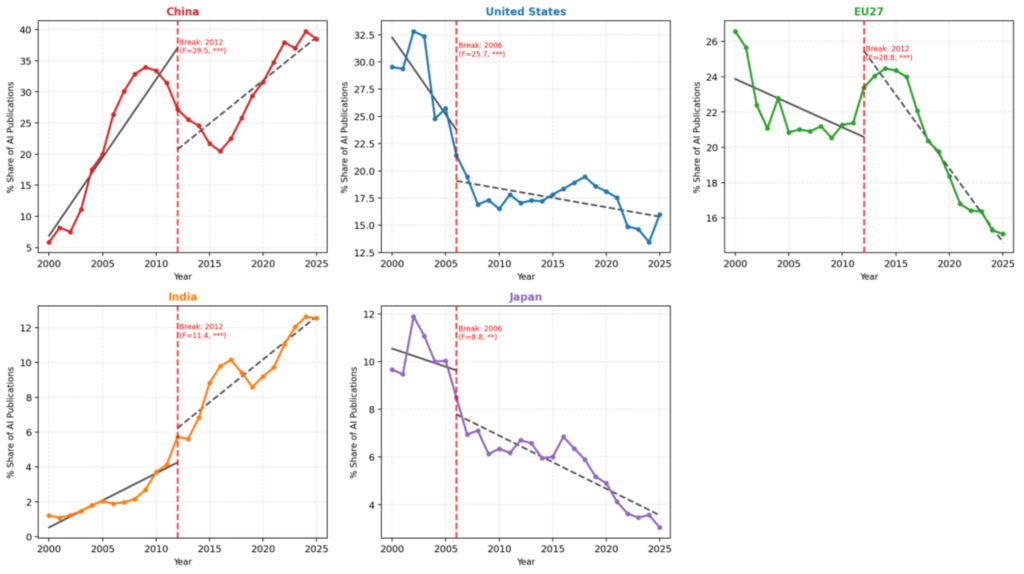
Figure 11 presents the quality-quantity analysis of AI publication shares in 2025 along with citation impact trajectories across the study period. Figure 11a shows that China is the only country positioned clearly above the quantity-equals-quality diagonal, with its share of high-impact publications (approximately 48%) substantially exceeding its share of all publications (approximately 38%). These findings indicate that China’s research output is disproportionately concentrated in high-impact work relative to its volume. The US and EU27 both sit very close to the diagonal, suggesting that their quality and quantity shares are roughly equivalent at approximately 13% to 14% each. Figure 11b demonstrates that the US maintained the highest citation impact per paper throughout the study period, but its high-impact advantage has declined rapidly, from approximately 70 citations per paper in 2000 to approximately 15 by 2025. Alternatively, China’s citation impact per paper has grown steadily to approximately 38 by 2025. This means China has surpassed the US on citation impact per paper since around 2018-2019. Figure 11 challenges the general assumption that Western powers retain dominance in high-impact AI scholarship. China’s dominance is no longer confined to publication volume but extends to research quality and citation impact.
Figure 11
Publication Volume, Research Quality, and Citation Impact of AI Research (2025)
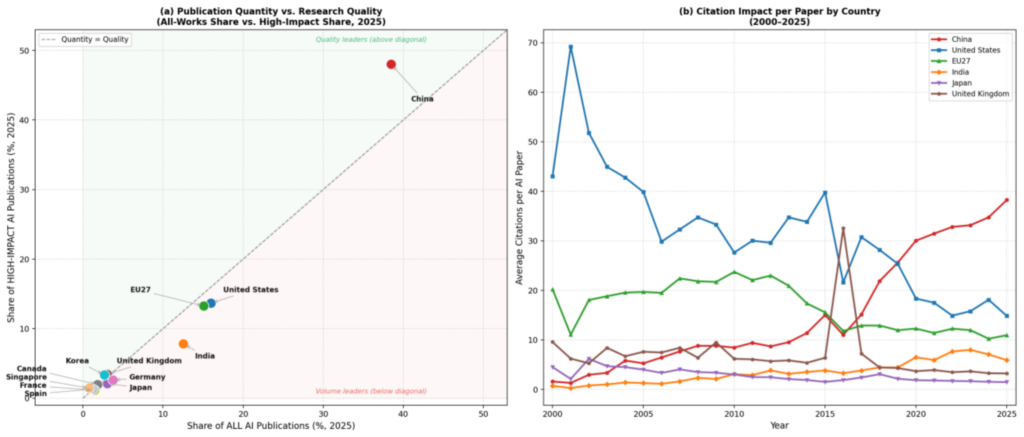
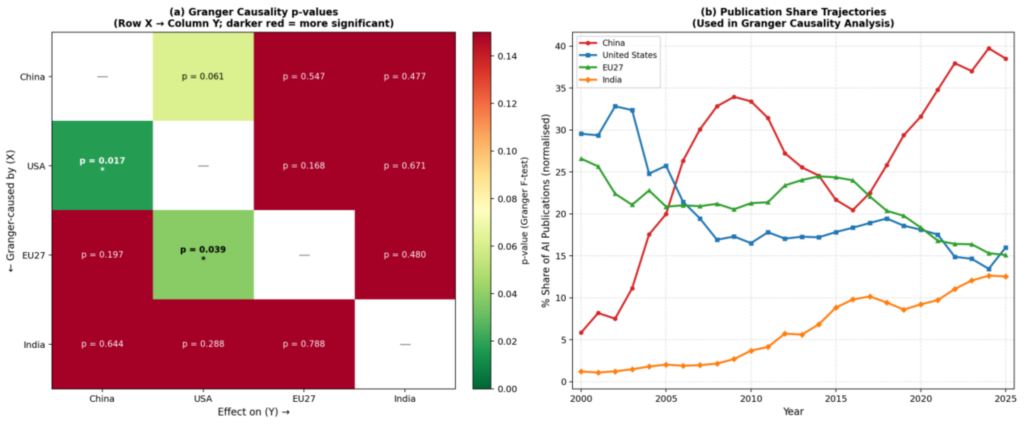
Figure 12 presents the Granger causality analysis of AI publication share dynamics across China, the US, EU27 and India. Out of all pairwise relationships tested in Figure 12(a), only two are statistically significant: US and China (p = 0.017) and EU27 and US (p = 0.039). Past values of the US publication share improve the prediction of China’s subsequent trajectory beyond what China’s own historical values predict alone. Likewise, past values of EU27 publication share improve the prediction of US’s subsequent trajectory beyond what US’s own historical values predict alone. I do not find any statistically significant predictive relationships among the remaining pairs. The empirical findings suggest that Western publication share trajectories carry statistically significant predictive power for subsequent Asian trajectories, whilst the reverse relationship is not supported by my data. It is noteworthy that Granger causality tests for statistical association and temporal precedence but not causation.
Figure 12:
Granger Causality Analysis of AI Publication Share Dynamics
Discussion
The empirical findings of this study reveal a profound restructuring of the global AI research landscape between 2000 and 2025. By using the metric of percentage of global AI publications by country, this research helps map the relative dominance trajectories of major global players. The data demonstrates a paradigm shift, characterised by the systemic, decades-long decline of the historic Western powerhouses (the US and the EU27) and the extraordinary, centrally-driven ascent of China.
The Decline of Western Dominance
The empirical findings for the US and the EU27 illustrate a clear decline of their collective global dominance in AI publications. In 2000, these two entities commanded a combined share of global AI publications exceeding 57% (27.56% for the US and 29.53% for the EU27). By 2025, their combined share has plummeted to approximately 24.41%. There are two thematic observations that can be made.
First, the US, while initially maintaining a high global share of AI publications, has seen its relative share reduced by more than half, falling to 12.01% in 2025. This decline, particularly noticeable during China’s mid-2000s and post-2020 surge periods (Figure 7 & Table 7), suggests that while the US research base remains highly influential (as examined in Figure 11b), its capacity to grow its share of the volume of foundational AI research is diminishing relative to global growth, particularly in Asia, led by China and India.
Second, the EU27 exhibits an even steeper and more consistent decline, dropping from nearly 30% to 12.40% over the period (Figure 1 & Table 1). This is exacerbated by the prominent decline of key individual member states like Germany and France, and the UK’s post-Brexit independent trajectory further diluting the collective European share. This European fragmentation of AI research output, even when combined, fails to provide a cohesive counterweight to the centralised national strategies of other regions, such as East Asia.
The Ascendancy of China and Asia, and Its Implications
The metric I use in this study indicates relative dominance. This does not mean the actual volumes of AI publications from the US and the EU27 have been declining. Instead, the empirical findings show the fall in global dominance from Western powers is associated with the ascendancy of Asian powers, led by China, in AI publications. The most notable findings are the dramatic, policy-driven shift in China’s trajectory in AI publications (Choi and Yoon, 2025). Sitting at a modest 4.90% in global share in 2000, China surpassed both the US and the EU27 in global AI publication share by the mid-2000s and has since solidified its position as the undisputed dominant single global player, reaching nearly 36% of the global total by 2025. First, China’s rapid and sustained growth, marked by significant positive YOY percentage changes (Figure 7 & Table 7), highlights the efficacy of centralised strategic investment in academic output (Podda, 2025). This dominance in publication volume suggests that a disproportionate share of the world’s new, foundational AI knowledge is originating from Chinese institutions (Ellis, 2025).
Second, the empirical findings indicate that there is a new global balance. Figure 6 and Table 6 demonstrate this shift: in 2025, China’s 35.91% share is close to the combined share of 45.64% from all other major global players (the US, EU27, the UK, Canada, Japan, Korea, Singapore, and India). This near parity between China and the rest of the global powers has profound geopolitical implications. The control over the production of foundational AI knowledge translates into strategic advantages in setting technical standards, developing proprietary technologies, and securing future economic competitiveness (Quimba & Barral, 2024).
Third, while today’s global focus remains on the US-China dynamics (Figure 4 & Table 4), the significant growth of India, whose share has grown from 1.13% to nearly 10% by 2025, signals the rise of a diversified, multipolar Asian research ecosystem. I can see that the combined share of AI publications by non-China Asian powers (India, Japan, Korea and Singapore) (Figure 2 & Table 2) has already exceeded that of the EU27 and the UK combined (Figure 1 & Table 1) in recent years. This indicates that the decline in Western dominance is not solely attributable to China but reflects a broader, fundamental shift of research gravity towards Asia.
Structural Concentration and Polarisation of Global AI Research
In addition to the geographical redistribution documented in Figure 1-7, the HHI (Figure 8) and convergence (Figure 9) analyses demonstrate a structural dimension of the global AI publication landscape that is not displayed when studying volume trajectories alone. The HHI analysis shows that global AI publication output has become progressively more concentrated since 2013, with a statistically significant upward trend confirmed by the Mann–Kendall test (τ=0.667, p=0.002). The convergence analysis reinforces this finding; the standard deviation of publication shares across countries has widened since 2013, and the β-convergence regression has no statistically significant evidence to suggest lower-share countries are closing the gap with dominant players. These findings indicate that the global AI publication is polarising structurally, where the already-dominant players are enjoying more advantages over time. Such findings carry policy implications. If the gap between dominant and non-dominant players continues to widen at the current rate, the likelihood of a more balanced distribution of global AI research output diminishes over time. For Western policymakers, their challenge is not just the need to reverse relative decline in publication share, but to address specific structural conditions, such as research funding fragmentation in the EU and the migration of high-impact researchers from academic to industry in the US.
China’s Dominance from Publication Volume to Research Quality
The quality-quantity analysis presented in Figure 11 represents the most insightful finding of this study, which helps reframe the narrative of Western decline in AI scientific output. The general assumption in academic and policy discourse has been that Western countries, especially the US, dominate high-impact AI scholarship, despite China leading in publication volume. However, Figure 11(a) challenges this general assumption. The figure shows that China is the only country whose share of high-impact publications substantially exceeds its share of all publications in 2025. Figure 11(b) further indicates that China’s average citations per paper has grown steadily from 2000 to 2025, and has surpassed that of the US since 2018-2019. The US citation impact per paper has declined rapidly from approximately 70 citations per paper in 2000 to approximately 15 by 2025. The findings indicate that China’s dominance is demonstrated in both its publication volume and high-impact work. The migration of high-impact researchers from Western academic institutions to private industry documented by Jurowetzki et al. (2021) and Bianchini et al. (2025), along with the fragmentation of EU research investment argued by Balland et al. (2025), plausibly explains why Western citation impact has declined while China’s has risen.
The Granger causality analysis presented in Figure 12 offers a further perspective to the understanding of the structural interpretation of global AI publication dynamics. The findings that past values of the US publication share improve the prediction of China’s subsequent trajectory, and that past values of EU27’s share improve the prediction of the US trajectory, are insightful. A plausible interpretation of these findings is that Western early dominance in publication activity has motivated Asian research system to subsequently respond. As Western institutions established research directions and publication norms, Asian systems, especially China’s, were encouraged to boost the publication outputs subsequently. Another interpretation is that research priorities and methodological frameworks developed in Western academic contexts were subsequently adopted and scaled by Asian institutions. These possible interpretations remain speculative, as the Granger causality test (demonstrated in Figure 12) establishes that the statistical association but not causal relationship exists. These findings suggest that the relationship between Western and Asian AI publication trajectories, from 2000 to 2025, may not be on a competitive basis, but may show a certain degree of historical interdependence.
Conclusions
This study set out to examine and comparatively analyse the trajectories of global countries dominating AI publications between 2000 and 2025. By utilising the percentage of global AI publications by country as the core metric, the research effectively quantified the dramatic transition of the global AI research landscape. My analysis results in five core conclusions:
- The primary conclusion is the decisive ascendancy of China, which increased its share of global AI publications from less than 5% in 2000 to nearly 36% by 2025. This makes China the single most dominant contributor to global AI research volume, significantly outpacing any other major country or bloc.
- In contrast, the study confirms a sustained, systemic decline in the relative dominance of the historic, established AI players, namely the US and the EU27. Both have seen their individual shares reduced by over half, indicating that their output growth has failed to keep pace with the exponential global expansion of AI research, largely driven by Asian economies.
- The research indicates a broader geographical shift of the AI research frontier towards Asia, evidenced by the substantial growth of India’s contribution alongside China’s dominance. This suggests that the current global AI race is increasingly a multipolar competition rooted in Asian research ecosystems.
- The shift in publication dominance serves as a leading indicator of strategic capability. The concentration of foundational AI knowledge production in a single country (China) disrupts the geopolitical balance, urging the necessary strategic re-evaluation of AI-related research funding and collaboration policies across Western powers and the EU bloc to ensure technological resilience and competitive advantage. Furthermore, the Granger causality analysis outputs indicate a degree of historical interdependence between Western and Asian AI research systems which policymakers should take into account when designing international research collaboration frameworks.
- China’s dominance in global AI research is no longer confined to publication volume. The quality-quantity analysis demonstrates that China’s share of high-impact publication exceeds its share of overall publications in 2025, and its average citations per paper has surpassed the US. These empirical outputs indicate China’s comprehensive research leadership that challenges the general assumption where Western countries retain dominance in high-impact AI scholarship.
This study has several limitations that should be acknowledged. First, the classification of AI publications relies on field-of-study tagging that follows the OECD standards. Papers in adjacent fields such as natural language processing or computer vision are only included if they are concurrently classified under core AI or machine learning categories. This means the datasets I used likely undercount the full breadth of AI-relevant scholarship. Second, whilst the Granger causality analysis identifies statistically significant predictive relationships between Western and Asian publication trajectories, it does not explain why past values of one country’s publication share predict another’s. Third, publication figures for 2025 should be interpreted with the acknowledgement that the datasets I used may not fully cover publications from late 2025 due to indexing delays. Therefore, the 2025 data should be seen as provisional but not complete.
Bio: Jason Hung is a Pulse Research Fellow at the Internet Society. His ORCID is at https://orcid.org/0000-0002-0267-3925.
References
1. Abbonato, D., Bianchini, S., Gargiulo, F., & Venturini, T. (2024). Interdisciplinary Research in Artificial Intelligence: Lessons from COVID-19. Quantitative Science Studies, 5(4), 922-35. https://doi.org/10.1162/qss_a_00329.
2. Aldasoro, I., Gambacorta, L., Korinek, A., Shreeti, V., & Stein, M. (2024). Intelligent Financial System: How AI Is Transforming Finance. BIS Working Papers No. 1194. Monetary and Economic Department of the Bank for International Settlements.
3. Balland, P., Di Girolamo, V., Benoit, F., Ravet, J., & Hobza, A. (2025). Divided We Fall Behind: Why a Fragmented EU Cannot Compete in Complex Technologies. Publications Office of the European Union. https://doi.org/10.2777/8548441.
4. Bertelsmann Foundation (2023). Infographic: AI Research and Development in the U.S., EU and China. Retrieved from https://www.bfna.org/digital-world/infographic-ai-research-and-development-in-the-us-eu-and-china-4mk29rb8ig/ (Accessed September 21, 2025).
5. Bruce, A., Timmerman, L., Fiakpui, N., Lessey, L., Beardah, M., Daeid, N., & Menard, H. (2025). A Scientometric Review of Explosives Research: Challenges and Opportunities. Forensic Science International, 373: 112513. https://doi.org/10.1016/j.forsciint.2025.112513.
6. Carlo, A. (2021). Artificial Intelligence in the Defence Sector. In Mazal, J., Fagiolini, A., Vasik, P., & Turi, M. (Eds.), Modelling and Simulation for Autonomous Systems. Modelling and Simulation for Autonomous Systems (MESAS) 2020. Lecture Notes in Computer Science, 12619. https://doi.org/10.1007/978-3-030-70740-8_17.
7. Carchiolo, V., & Malgeri, M. (2024). Navigating the AI timeline: From 1995 to today. In Proceedings of the 13th International Conference on Data Science, Technology and Applications (DATA 2024) (pp. 577–84). SciTePress. https://doi.org/10.5220/0012856700003756.
8. Choi, C. & Yoon, J. (2025). AI Policy in Action: The Chinese Experience in Global Perspective. Journal of Policy Studies, 40(2): 1-23. https://doi.org/10.52372/jps.e685 (Accessed September 20, 2025).
9. Ellis, D. (2025). New Report Shows China Dominates in AI Research—and Is Western World’s Leading Collaborator on AI. Digital Science. Retrieved from https://www.digital-science.com/blog/2025/07/new-report-shows-china-dominates-in-ai-research/ (Accessed September 20, 2025).
10. Färber, M., & Tampakis, L. (2024). Analysing the Impact of Companies on AI Research Based on Publications. Scientometrics, 129, 31–63. https://doi.org/10.1007/s11192-023-04867-3.
11. Gao, X., Wu, Q., Liu, Y., & Yang, R. (2024). Pasteur’s Quadrant in AI: Do Patent-Cited Papers Have Higher Scientific Impact? Scientometrics, 129(2), 909–32. https://doi.org/10.1007/s11192-023-04925-w.
12. Gerlich, M. (2024). Brace for Impact: Facing the AI Revolution and Geopolitical Shifts in a Future Societal Scenario for 2025–2040. Societies, 14(9): 180. https://doi.org/10.3390/soc14090180.
13. Gohil, M. (2023). A Study on the Impact of Artificial Intelligence (AI), Automation and the Digital Transformation on Society, 3(4). Revista Review Index Journal of Multidisciplinary, 3(4), 22-27. https://doi.org/10.31305/rrijm2023.v03.n04.004.
14. Hamilton-Hart, N. & Yeung, H. (2021). Institutional Under Pressure: East Asian States, Global Markets and National Firms. Review of International Political Economy, 28(1), 11-35. https://doi.org/10.1080/09692290.2019.1702571.
15. Hong, S. Zhong, D., & Um, K. (2025). The Impact of Artificial Intelligence (AI) Adoption on Operational Performance in Manufacturing. Journal of Manufacturing Technology Management, 1-23. https://doi.org/10.1108/JMTM-03-2025-0227.
16. Hood, W. W., & Wilson, C. S. (2001). The Literature of Bibliometrics, Scientometrics, and Informetrics. Scientometrics, 52, 291–314. https://doi.org/10.1023/A:1017919924342.
17. LeCun, Y., Bengio, Y., & Hinton, G. (2015). Deep Learning. Nature, 521, 436–44. https://doi.org/10.1038/nature14539.
18. Jurowetzki, R., Hain, D., Mateos-Garcia, J., & Stathoulopoulos, K. (2021). The Privatisation of AI Research(-ers): Causes and Potential Consequences—From University-Industry Interaction to Public Research Brain-Drain? arXiv. https://arxiv.org/abs/2102.01648.
19. Jurowetzki, R., Hain, D., Wirtz, K., & Bianchini, S. (2025). The Private Sector is Hoarding AI Researchers: What Implications for Science? AI & Society, 40, 4145–52. https://doi.org/10.1007/s00146-024-02171-z.
20. Khan, M., Khan, H., Omer, M., Ullah, I., & Yasir, M. (2024). Impact of Artificial Intelligence on the Global Economy and Technology Advancements. In Hajjami, S., Kaushik, K., & Khan, I. (Eds.), Artificial General Intelligence (AGI) Security. Advanced Technologies and Societal Change. Springer. https://doi.org/10.1007/978-981-97-3222-7_7.
21. Liu, N., Shapira, P., & Yue, X. (2021). Tracking Developments in Artificial Intelligence Research: Constructing and Applying a New Search Strategy. Scientometrics, 126(4), 3153–92. https://doi.org/10.1007/s11192-021-03868-4.
22. Mahdi, S., Battineni, G., Khawaja, M., Allana, R., Siddiqui, M., & Agha, D. (2023). How Does Artificial Intelligence Impact Digital Healthcare Initiatives? A Review of AI Applications in Dental Healthcare. International Journal of Information Management Data Insights, 3(1): 100144. https://doi.org/10.1016/j.jjimei.2022.100144.
23. Mingers, J. & Leydesdorff, L. (2015). A Review of Theory and Practice in Scientometrics. European Journal of Operational Research, 246(1), 1-19. https://doi.org/10.1016/j.ejor.2015.04.002.
24. OECD.ai Observatory (n.d.). OpenAlex. Retrieved from https://oecd.ai/en/openalex (Accessed September 20, 2025).
25. Podda, L. (2025). China’s Drive to Dominate the AI Race. Atlas Institute for International Affairs. Retrieved from https://atlasinstitute.org/chinas-drive-to-dominate-the-ai-race/ (Accessed September 20, 2025).
26. Priem, J., Piwowar, H., & Orr, R. (2022). OpenAlex: A Fully-Open Index of Scholarly Works, Authors, Venues, Institutions, and Concepts. arXiv. https://doi.org/10.48550/arXiv.2205.01833.
27. Quimba, F. & Barral, M. (2024). ASEAN Centrality amid Increasing Global Multipolarity. PIDS Discussion Paper Series, No. 2024-38. Philippine Institute for Development Studies. https://doi.org/10.62986/dp2024.38 (Accessed September 20, 2025).
28. Sinha, A., Shen, Z., Song, Y., Ma, H., Eide, D., Hsu, B., & Wang, K. (2015). An Overview of Microsoft Academic Service (MAS) and Applications. In Proceedings of the 24th International Conference on World Wide Web (WWW ’15 Companion) (pp. 243–6). ACM. https://doi.org/10.1145/2740908.2742839.
29. Stanford University Human-Centered Artificial Intelligence (HAI) (n.d.). The Global AI Vibrancy Tool. Retrieved from https://hai.stanford.edu/ai-index/global-vibrancy-tool (Accessed September 20, 2025).
30. Wang, K., Shen, Z., Huang, C., Wu, C., Eide, D., Dong, Y., Qian, J., Kanakia, A., Chen, A., & Rogahn, R. (2019). A Review of Microsoft Academic Services for Science of Science Studies. Frontiers in Big Data, 2: 45. https://doi.org/10.3389/fdata.2019.00045.
Preprint
This paper is available as a preprint on arXiv: https://arxiv.org/abs/2509.25298
Cite This
Hung, J. (2026). Trajectories and Comparative Analysis of Global Countries Dominating AI Publications, 2000–2025. AI in Society. https://aiinsocietyhub.com/articles/research-ai-publications-global-dominance-2000-2025